The traditional image of a university student involves late nights, caffeine-fueled marathons, and a desk buried under a mountain of library books. However, a new wave of students is trading the “struggle-bus” mentality for a more modern framework: the Creator Economy approach. Content creators, influencers, and digital entrepreneurs have mastered the art of high-output productivity by treating their time as a finite resource and their energy as a business asset. By applying these same principles to higher education, undergraduates can navigate heavy workloads with far more efficiency and far less burnout.
Modern academic success isn’t just about how much you know; it’s about how well you manage the production cycle of your degree. In a world where students are often balancing internships, social media presence, and side hustles, the need for streamlined systems is critical. Many students are now adopting professional workflows to write my assignment online, treating their academic papers as “deliverables” that require research, drafting, and quality control phases rather than chaotic, last-minute scrambles. This shift in mindset allows for a more balanced lifestyle where the “Main Character” of the story isn’t a stressed-out student, but a strategic manager of their own success.
The “Output-First” Mindset: Efficiency Over Effort
In the creator economy, “busy” doesn’t always mean “productive.” A YouTuber might spend ten hours editing a video, but if the storytelling is weak, the effort is wasted. Similarly, in university, spending twelve hours in the library doesn’t guarantee an A if those hours weren’t spent on high-impact tasks like thesis refinement or rubric alignment.
To manage assignments like a pro, you must categorize your tasks based on the ROI (Return on Investment). High-value tasks include thesis development, primary research, and exam preparation. Low-value or repetitive tasks include formatting citations, basic data entry, or summarizing well-established introductory concepts. By identifying these early, you can allocate your peak energy hours to the hardest tasks and save the “admin” work for when your brain is tired.
Developing Your Academic Tech Stack
Every successful creator has a “tech stack”—a collection of tools that automate the boring stuff so they can focus on the creative stuff. Your university career should be no different. This involves moving away from just a pen and paper and toward a digital ecosystem that supports your workflow.
| Tool Category | Creator Equivalent | Student Benefit |
| Project Management | Notion / Trello | Tracking deadlines and modularizing tasks. |
| Information Capture | Obsidian / Evernote | Building a “Second Brain” for lecture notes. |
| Content Optimization | Grammarly / Hemingway | Ensuring professional tone and readability. |
| Strategic Delegation | Expert Consultants | Outsourcing low-impact, high-time tasks. |
The Power of Strategic Delegation
One of the best-kept secrets of the creator economy is that no one does it alone. Successful influencers have editors, scriptwriters, and managers. In the academic world, delegation is often misunderstood, but when used strategically, it is a professional skill. It’s about recognizing when your “bandwidth” is full.
For instance, when a student is facing three major finals and two 3,000-word essays in the same week, something has to give. Making the executive decision to pay someone to do my homework for a minor elective allows for better focus on the core subjects that actually matter for your future career. Using a service from MyAssignmentHelp naturally integrates into this professional workflow, providing the same kind of support a creator gets from an expert consultant. It isn’t about skipping the work; it’s about managing a high-volume output without compromising on quality or mental health. This approach mirrors how a CEO operates—focusing on the vision while delegating the execution of specific technical components.
The “Modular” Writing Process: Breaking the Wall
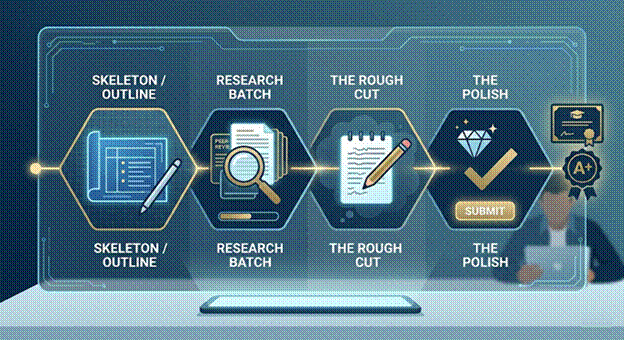
Professional creators don’t sit down and create a masterpiece in one go. They work in modules: thumbnails first, then a script outline, then b-roll. You can apply this to essay writing to make it feel less daunting. Start with “The Skeleton” (The Outline)—never start with a blank page. Map out your headings first to create a roadmap. Follow this with “The Research Batch,” where you gather all your sources in one dedicated hour. Don’t write yet; just collect.
Next comes “The Rough Cut,” where you write your first draft without worrying about grammar or perfection. Just get the ideas down. Finally, move into “The Polish” phase, where you refine your voice and check your citations. By breaking the process into these distinct stages, you avoid the overwhelm of trying to do everything at once.
Information Gain: The Key to Ranking and Grades
In SEO and digital marketing, “Information Gain” is the secret to ranking on the first page of Google. It means providing something new that isn’t already in the top ten results. In university, this is what professors call “Originality.” To stand out, don’t just parrot the textbook. Look for the “Educational Gap.” Find a unique case study or a modern digital trend that connects back to your topic.
If you are writing about economics, discuss the nuances of the creator economy and decentralized finance. If you are writing about psychology, look into the impact of algorithmic feeds on attention spans. This unique perspective shows your professor (and the Google algorithm) that you are providing high-value, expert-level content. It demonstrates that you aren’t just consuming information, but synthesizing it into something new.
Managing the “Academic Brand”
Think of your degree as a brand launch. Every assignment you submit is a product released to your “audience” (your professors). If your quality is inconsistent, your brand value drops. Maintaining a high standard across all modules requires a level of consistency that is hard to maintain alone. Pros in the digital world use templates and style guides to ensure every piece of content looks the same.
Students can do the same by creating a personal “Style Sheet” for their essays—standardized margins, font choices, and citation formats. When your work looks professional, it is treated with more respect. This attention to detail is what separates a student who is just “getting by” from one who is dominating their field.
Navigating the 2026 Academic Landscape
The current academic year has introduced new challenges, including the rise of generative engines and AI-assisted learning. To remain competitive, students must lean into their “Human-Centric” skills. While AI can summarize data, it cannot provide personal experience, ethical nuance, or deep contextual understanding.
The Creator Economy approach emphasizes personal voice. Your essays should feel like they were written by a person with a distinct perspective. Use clear, active language. Avoid the “academic fluff” that students often use to meet word counts. Instead, focus on density—how much actual information can you pack into every paragraph? This is how you win in both the classroom and the Google search rankings.
Long-Term Sustainability and Mental Health
Finally, the most important lesson from creators is sustainability. Many influencers burn out because they try to do everything themselves. The “hustle culture” of 20th-century academics is being replaced by “flow culture.” This is the practice of working in high-intensity bursts followed by deep rest.
By treating your assignments as projects, using professional tools, and strategically delegating when necessary, you protect your mental health. You move from a state of constant anxiety to a state of controlled management. You aren’t just a student anymore; you are a content strategist for your own education.
Frequently Asked Questions (FAQ)
Q.1. Is the “Creator Approach” suitable for all majors?
Ans: Absolutely. Whether you are in STEM or the Arts, treating your assignments as project deliverables rather than “homework” helps in organizing complex data and meeting tight deadlines effectively. It works especially well for technical subjects like Nursing or Law where the volume of information is high.
Q.2. How does delegating tasks help my learning process?
Ans: By delegating repetitive or lower-weight tasks, you free up “cognitive bandwidth” to dive deeper into core subjects. It allows you to study more effectively by focusing on the 20% of work that yields 80% of your grade results. It’s about working on the business of your degree, not just in it.
Q.3. What is the best way to avoid burnout during finals?
Ans: Modularize your schedule. Don’t look at the whole month; look at the next four hours. Use the same “sprint” techniques that software developers and digital creators use to stay productive without hitting a wall. Prioritize sleep and hydration as if they were business expenses.
Q.4. How can I ensure my writing sounds human and professional?
Ans: Read your work aloud. If it sounds like something you’d never say in a professional conversation, simplify it. Focus on clarity, use active voice, and avoid “filler” words that add length but no value. Google and your professors both prefer direct, insightful communication over vague complexity.
Q.5. How do I balance multiple assignments at once?
Ans: Use a project management tool to visualize your “pipeline.” See which assignments are in the “Research” phase, which are in “Drafting,” and which are ready for “Final Review.” This prevents you from being surprised by deadlines.
About The Author
Hi, I’m Lucy Wilson. As a senior academic consultant and content strategist at MyAssignmentHelp, I focus on bridging the gap between classroom theory and professional career readiness. With years of experience in the educational sector, I specialize in developing modular study workflows and technical literacy guides that help students across the UK, US, and Australia navigate high-pressure academic cycles.