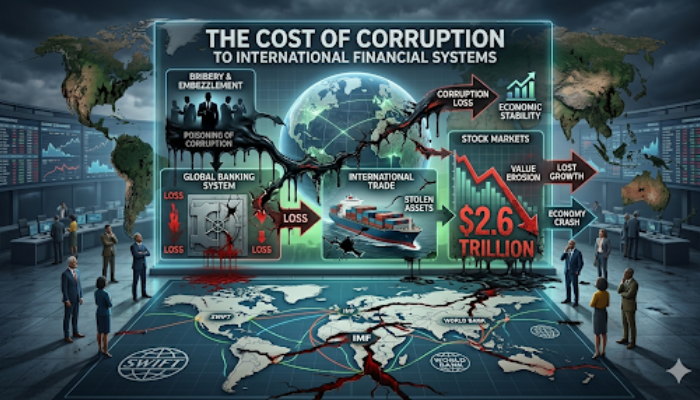
Global corruption is still one of the most severe challenges to the world’s economy. Bribery and embezzlement, money laundering and financial fraud, etc. all erode trust in governments, financial institutions and international markets. The repercussions are not just national, but also cross-border trade, investment migration and banking system stability. Weak governance and restricted regulatory supervision in many of the most corrupt countries in the world provide opportunities for financial systems to be used in criminal activities by criminal networks.
With financial crime becoming more complex by the day, enterprises and financial institutions are spending huge resources on advanced Fraud Detection system technologies to minimize the risks and meet global standards. If unchecked, corruption can jeopardize economic development and thus long-term stability of global financial systems.
How Corruption Hurts Financial Systems
Financial institutions are directly impacted by corruption in their efficiency and transparency. If government, businesses or financial intermediaries engage in illegal activities, public confidence in the banking sector decreases. Investors may also be hesitant to invest in high-risk regions, and international financial institutions may restrict their interactions with local financial institutions in countries with a history of corruption.
The economic cost is huge! Corruption not only leads to loss of tax revenues but also makes it more costly to do business and stimulates illegal financial flows. Criminal organizations frequently rely on shell companies, fake transactions and offshore accounts to conceal illegally-acquired assets. This puts extra strain on banks and regulators to enhance compliance steps and put into action more robust Fraud Detection solutions.
Financial institutions are very susceptible because they deal with millions of transactions each day. If not monitored properly, suspicious transactions can easily go unnoticed. This has led to a more stringent anti-money laundering regime, which is being implemented by regulators around the world to prevent crimes committed for corruption.
There is a connection between corruption and money laundering
Corruption and money laundering go hand in hand. The stolen funds are often placed in many accounts and jurisdictions to trick corrupt officials into not recognizing the money. In the least corrupt nations, legal systems are weak, favoring easier and more undetected transfer of illegal funds by criminals.
Today, banks use technology-based compliance systems to detect transactions or activities that are unusual or risky. A sophisticated Fraud monitoring system can uncover abnormal payment trends, unusual customer activity and concealed connections between accounts. These systems enable financial institutions to mitigate financial crimes risk and comply with international financial crime standards.
There are a number of tell-tale signs that may be associated with corrupt financial transactions:
- Major transactions that do not have a sound business rationale.
- Regular transfers to and from offshore accounts
- Employing shell companies to conceal the beneficial ownership of companies.The use of shell companies to disguise the beneficial ownership of companies.
- High value cash deposits by politically exposed people.
- The speed of financial transactions with several jurisdictions.
These are indicators that aid with compliance teams in risk identification before it turns into bigger financial crimes.
Advanced fraud detection technologies are essential for businesses today
Corruption is changing and companies need more intelligent tools to defend their operations. Conventional manual reviews cannot keep up with the sophisticated laundering schemes and fraudulent activity. That is why businesses are increasingly implementing Fraud detection services powered by AI to beef up financial controls.
Today’s fraud prevention tools process huge amounts of data instantaneously. Machine learning algorithms can detect suspicious patterns that may be missed by human analysts. These technologies help reduce false positives in transaction monitoring processes and enhance operational efficiency.
The rising need for AML fraud detection systems is driven by the heightened regulatory scrutiny on financial institutions under international laws and AML guidelines like FATF recommendations and AML directives. AML strategies will not only mitigate financial risks, but they also help organizations protect themselves against penalties and erode their reputation costs.
Fraud Triangle in Corruption Cases
Fraud triangle is a very common concept used to understand the reasons for financial crimes. It has three components pressure, opportunity and rationalisations. These factors may be more likely to promote fraud in very corrupt settings.
Pressure could be financial or political, opportunity is when internal controls are weak or regulatory oversight is lacking. Rationalization enables people to excuse unethical conduct while maintaining a belief that their actions are justified and appropriate or they must do it.
The Fraud triangle is an important tool for organisations to develop effective compliance programmes and strengthen internal controls. Organizations that focus on transparency and accountability are better able to manage risks associated with corruption.
The global fight against corruption
International cooperation to tackle corruption and financial crime remains strong, with governments, regulators and financial institutions doing their part to enhance cooperation. More sophisticated compliance solutions, tougher laws and international intelligence-sharing are increasingly becoming a necessary part of the financial system’s armour.
But technology is not the answer to the problem. It’s also important for organizations to establish ethical corporate cultures, carry out regular audits and have thorough risk management strategies in place. When man is supplemented by intelligent monitoring systems, it’s easier to establish a robust anti-corruption, anti-illicit finance arm.
Conclusion
The price of corruption to international financial systems is not just in terms of financial losses but also in the loss of trust, a deterioration in institutions and slower economic growth. In the very corrupt nations, the problems are particularly acute because there’s not enough oversight that allows the crimes to flourish.
In response to these risks, financial institutions are increasingly investing in modern Fraud Detection system technologies, improved AML fraud detection frameworks and powerful Fraud Detection solutions. In doing so, organizations can better prevent financial crimes and contribute to a more secure and stable global economy while boosting transparency and enhancing compliance.